
Best Raksha Bandhan Gift for a Pregnant Sister? Give Her Something She’ll Feel Every Day
April 08, 2026
Discover powerful Garbh Sanskar mantras to chant during pregnancy. Which mantra, when to start & baby brain benefits. Backed by research.
Verified by: Prof. Hardik Upadhyay | Updated on: April 08, 2026

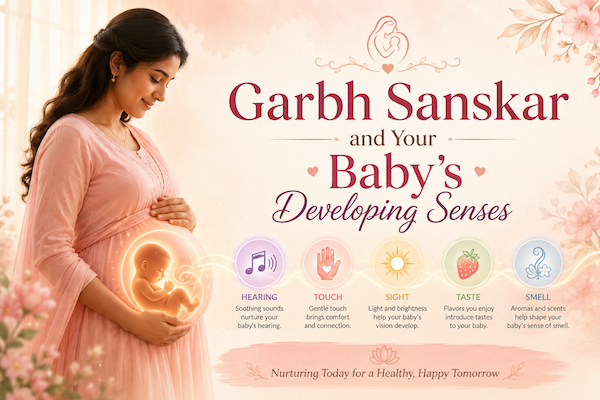

Imagine your unborn baby absorbing the gentle rhythm of an ancient Sanskrit verse — chanted softly by your voice, felt as a warm vibration through the womb. This is not mythology. This is Garbh Sanskar.
Garbh Sanskar mantras are one of the most powerful elements of holistic prenatal care — and one of the most misunderstood. Millions of Indian mothers chant or listen to mantras during pregnancy. But very few know the answers to the questions that actually matter: Which mantra should I chant? When do I start? How long should I chant? And what does modern science — including epigenetics — actually confirm about the impact of sacred sound on a developing baby?
This complete guide is created by the expert team at Garbh Sanskar Guru — India's No. 1 Garbh Sanskar app, backed by a peer-reviewed study on 1,323 mothers, trusted by 20 Lakh+ mothers in 63+ countries. Everything here is grounded in both classical Vedic wisdom and contemporary research.
Whether you are newly pregnant, in your third trimester, or planning a pregnancy — read this once, and you will know exactly what to chant, when to start, and why it works.
|
Get My Free Daily Garbh Sanskar Mantra Plan Personalised daily mantra sessions guided by trimester — with expert support, yoga & more. 📱 Download Free — Android (Google Play) | Download Free — iOS (App Store) Trusted by 20 Lakh+ mothers across 63+ countries | World's No. 1 Garbh Sanskar App |
A Garbh Sanskar mantra is a sacred Sanskrit sound formula chanted or listened to during pregnancy with the specific intention of nurturing the unborn child's physical, mental, and spiritual development.
The word Garbh (गर्भ) means womb, and Sanskar (संस्कार) means the imprinting of values and virtues. Mantras in the Garbh Sanskar tradition are drawn from the four Vedas — Rigveda, Samaveda, Yajurveda, and Atharvaveda — each selected for its specific vibrational frequency, its effect on the mother's nervous system, and its ability to create a positive womb environment.
Critically, Garbh Sanskar mantra practice is not restricted by religion or background. Its benefits — cortisol reduction, heart rate regulation, improved fetal oxygenation — are physiological. They work regardless of the chanter's faith. Mothers of all backgrounds across 63+ countries have experienced these benefits through the Garbh Sanskar Guru programme.
The key difference between a mantra and a shloka: a mantra is a short, repetitive sound formula (e.g., Om Namah Shivaya) whose power comes from vibration and repetition. A shloka is a longer scriptural verse (e.g., from the Bhagavad Gita) that carries narrative meaning. Both are used in Garbh Sanskar — mantras for daily chanting and shlokas for listening and contemplation, particularly in the second and third trimester.
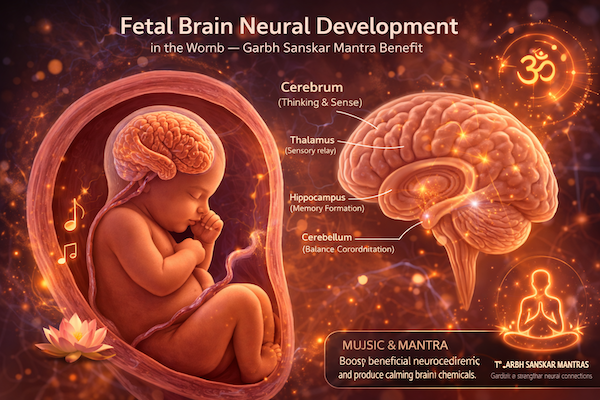
1. The Baby Begins Hearing From Week 16
Fetal auditory development begins at approximately Week 16, with the baby clearly responding to external sounds by Week 23–24. Neuroscience confirms that rhythmic, repetitive patterns of sound — precisely the structure of mantras — are the most effective stimuli for early neural pathway formation in the developing brain.
High cortisol (the stress hormone) in the mother's bloodstream directly crosses the placental barrier and affects fetal brain development and temperament. Research in prenatal psychology confirms that mantra chanting activates the parasympathetic nervous system — reducing cortisol, lowering blood pressure, and triggering the release of oxytocin and serotonin. These positive neurochemicals also cross the placenta, creating the optimal biochemical environment for fetal growth.
The science of epigenetics has transformed our understanding of prenatal influence. Epigenetics shows that the mother's environment, emotions, and lifestyle choices can switch fetal genes on or off without changing the DNA sequence itself. A mother in chronic stress will epigenetically programme her baby's stress-response system toward anxiety. A mother in calm, positive states — created by practices like mantra chanting — programmes the baby's developing neurology toward resilience, emotional balance, and cognitive capacity. This is exactly the mechanism behind Garbh Sanskar.
A research study conducted by Garbh Sanskar Guru on 1,323 mothers — peer-reviewed and published — found that a consistent Garbh Sanskar lifestyle including mantra practice significantly improved maternal mental well-being, resulting in healthier birth weights and a measurably lower incidence of preterm delivery. This is the only study of its kind conducted by a dedicated Garbh Sanskar organisation in India.
|
▶ Watch on YouTube — Majestic Garbh Sanskar Official Channel Garbh Sanskar Path:1 | गर्भ संस्कार का वैदिक सिद्धांत और 16 संस्कार | by Majestic Garbh Sanskar Understand the Vedic foundation of Garbh Sanskar — the 16 Sanskars and the principles that underpin mantra practice. The perfect starting point before beginning your daily mantra routine. |
The following mantras are recommended by the expert team at Garbh Sanskar Guru, curated from classical Vedic texts and validated through practical application across our Garbh Sanskar classes, our 100+ track audio library in the app, and our offline Garbh Sanskar centres.
|
1. Gayatri Mantra — For Intelligence, Wisdom & Cognitive Development ॐ भूर्भुवः स्वः | तत्सवितुर्वरेण्यं | भर्गो देवस्य धीमहि | धियो यो नः प्रचोदयात्Om Bhur Bhuvah Swaha | Tat Savitur Varenyam | Bhargo Devasya Dhimahi | Dhiyo Yo Nah Prachodayat Meaning: We meditate upon the divine light of the Sun God (the supreme consciousness). May that light illuminate and inspire our intellect. Pregnancy Benefit: The most universally recommended Garbh Sanskar mantra. Its 24-syllable structure activates the prefrontal cortex — the seat of higher reasoning. Reduces maternal anxiety, stimulates neural pathway formation, and epigenetically programmes the baby's developing brain toward curiosity and intelligence. Recommended from the 1st trimester through delivery. |
|
2. Om Namah Shivaya — For Deep Peace & Surrender ॐ नमः शिवाय | Om Namah Shivaya Meaning: I bow to the divine inner self — to the consciousness that pervades all existence. Pregnancy Benefit: A five-syllable Panchakshara mantra aligned with the five elements (earth, water, fire, air, ether). The most accessible mantra for daily repetition. Measurably reduces cortisol within minutes of chanting. Ideal for the first trimester when anxiety and nausea are highest. Suitable throughout all trimesters. |
|
3. Mahamrityunjaya Mantra — For Protection, Health & Immunity ॐ त्र्यम्बकं यजामहे | सुगन्धिं पुष्टिवर्धनम् | उर्वारुकमिव बन्धनान् | मृत्योर्मुक्षीय माऽमृतात्Om Tryambakam Yajamahe | Sugandhim Pushtivardhanam | Urvarukamiva Bandhanan | Mrityor Mukshiya Maamritat Meaning: We worship the three-eyed Lord Shiva — the sustainer of life. May he free us from illness and fear, as a ripened fruit is freed from its stem. Pregnancy Benefit: Strongly recommended for maternal immunity, physical health, and protection of the unborn baby. Particularly beneficial in the 2nd and 3rd trimester as all major fetal organs are forming. Associated with the production of protective neuropeptides. Also powerful for managing pregnancy fear and birth anxiety. |
|
4. Garbh Sanskar Sutra — The Sacred Womb Blessing ॐ गर्भं रक्ष | ॐ गर्भं पुष्य | ॐ गर्भं वर्धयOm Garbham Raksha | Om Garbham Pushya | Om Garbham Vardhaya Meaning: Om — protect the womb. Om — nourish the womb. Om — grow the womb. Pregnancy Benefit: Composed specifically for pregnancy, used in Punsavan Sanskar and Simantonnayana Sanskar rituals. Directly invokes protection and nourishment for the unborn child. A daily practice in the Garbh Sanskar Guru app. Particularly powerful when chanted by the mother while placing both hands gently on the belly. |
|
5. Saraswati Vandana — For Knowledge, Creativity & Learning या कुन्देन्दु तुषारहार धवला | या शुभ्रवस्त्रावृता | या वीणावरदण्डमण्डितकरा | या श्वेतपद्मासनाYa Kundendu Tusharahara Dhavala | Ya Shubhravastravrita | Ya Veenavaradandamanditakara | Ya Shvetapadmasana... Meaning: O Goddess Saraswati — pure as white jasmine, clothed in white, adorned with the veena, seated on a white lotus — bestow upon us wisdom and learning. Pregnancy Benefit: Invokes the goddess of knowledge, arts, and learning. Recommended from the 5th month onwards when the baby's sensory development becomes active. Nurtures qualities of curiosity, creativity, and intellectual openness in the child. Widely used in Garbh Sanskar online classes and the daily app activity for babies in months 5–9. |
|
6. Hanuman Chalisa — For Strength, Courage & Positivity जय हनुमान ज्ञान गुण सागर | जय कपीस तिहु लोक उजागरJai Hanuman Gyan Gun Sagar | Jai Kapis Tihu Lok Ujagar... Meaning: Victory to Hanuman, ocean of wisdom and virtue, illuminator of the three worlds, the faithful messenger of Lord Ram. Pregnancy Benefit: The Hanuman Chalisa's repetitive 40-verse structure creates measurable cardiovascular calming in the mother. Its rhythm and metre are particularly effective for dispelling fear and negative thought patterns during pregnancy. Best listened to or chanted from the 4th month onwards. Also one of the most commonly practised Garbh Samvad mediums. |
|
7. Shanti Mantra — For Universal Peace (Perfect for Couples) ॐ सह नाववतु | सह नौ भुनक्तु | सह वीर्यं करवावहै | तेजस्वि नावधीतमस्तु | मा विद्विषावहैOm Saha Navavatu | Saha Nau Bhunaktu | Saha Viryam Karavavahai | Tejasvi Navadhitamastu | Ma Vidvishavahai Meaning: May we be protected together. May we be nourished together. May we work with great energy together. May our learning be illuminating. May there be no ill will between us. Pregnancy Benefit: This Upanishadic peace mantra is specifically recommended for both parents to chant together. The father's deeper vocal frequency vibrates at a range clearly perceptible to the fetus and creates a profoundly secure acoustic environment. A cornerstone couple practice in our Garbh Sanskar classes — used in Garbh Samvad sessions and as an evening family ritual. |
Mantra chanting and Garbh Samvad (talking directly to your baby in the womb) are the two most transformative prenatal bonding practices in Garbh Sanskar — and they work best together.
Garbh Samvad is the practice of consciously communicating with the unborn baby through your voice, thoughts, and intention. When a mother chants a mantra, she is engaging in the deepest form of Garbh Samvad — sending a consistent signal of calm, love, and positive intention into the womb, every single day.
Research on prenatal auditory development confirms that from Week 23 onwards, the baby not only hears the mother's voice but actively recognises its rhythm and tonal patterns. A baby who has experienced 20 minutes of mantra chanting daily for 4–5 months will recognise and respond to that sound pattern immediately after birth — settling faster, feeding more easily, and displaying measurably lower cortisol levels.
Garbh Samvad can include: speaking affirmations, telling the baby about your day, reading aloud from inspiring books, and chanting mantras. The Garbh Sanskar Guru app includes a dedicated Garbh Samvad section with guided scripts in all four languages — paired with the daily mantra schedule.
The most common question in our Garbh Sanskar classes online is: when should I start? The answer is clear: from day one of knowing you are pregnant — or ideally, during pregnancy planning. Here is the trimester-wise roadmap:
|
Trimester |
Weeks |
Recommended Mantras |
Duration/Day |
|
First |
1–12 |
Gayatri Mantra, Om Namah Shivaya, Shanti Mantra |
5–10 min |
|
Second |
13–26 |
Gayatri Mantra, Saraswati Vandana, Mahamrityunjaya Mantra |
15–20 min |
|
Third |
27–40 |
Hanuman Chalisa, Garbh Sanskar Sutra, Mahamrityunjaya Mantra |
15–20 min |
Although the baby cannot yet perceive external sound, the mother's biochemical environment — shaped by mantra chanting — reaches the fetus through hormones, oxygenation, and the stress response system. This is the epigenetic window. Keep sessions to 5–10 minutes. Focus on: Gayatri Mantra, Om Namah Shivaya, Shanti Mantra. Chanting or listening are equally effective.
From Week 16, fetal auditory processing begins. From Week 23, the baby clearly responds to the mother's voice. This is the optimal window for structured mantra practice. Build to 15–20 minutes daily, ideally paired with Garbh Sanskar yoga and pranayama. Add: Saraswati Vandana, Mahamrityunjaya Mantra. Begin Garbh Samvad in earnest.
The baby now fully recognises your voice and responds to familiar sound patterns. Many mothers in our Garbh Sanskar classes report their baby settling or moving in response to their specific chanting voice. Maintain 15–20 minutes daily. Emphasise: Hanuman Chalisa, Garbh Sanskar Sutra, Mahamrityunjaya. Also use mantra chanting as a calming tool for your own birth preparation.
|
Get My Trimester-Personalised Mantra Schedule The app automatically adjusts your daily mantras as your pregnancy progresses — week by week. 📱 Download Free — Android (Google Play) | Download Free — iOS (App Store) Trusted by 20 Lakh+ mothers across 63+ countries | World's No. 1 Garbh Sanskar App |
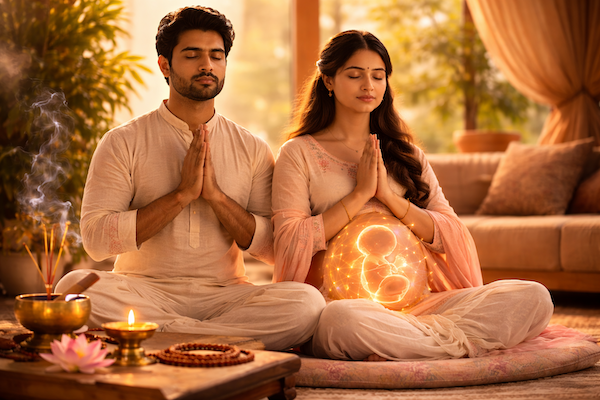
Posture: Sit comfortably in Sukhasana (easy cross-legged pose) or on a firm chair with spine upright. Rest both hands gently on your belly. This creates a physical connection between your voice vibration and the baby.
|
▶ Watch on YouTube — Majestic Garbh Sanskar Official Channel Subscribe: Majestic Garbh Sanskar — Official YouTube Channel | Daily Pregnancy Videos Watch daily expert videos on mantra practice, Garbh Samvad, pregnancy yoga, nutrition, and Garbh Sanskar guidance — from the team behind India's No. 1 Garbh Sanskar app. |
Individual practice is valuable. But structured expert guidance is transformative. Our Garbh Sanskar classes — online and offline — offer:
Over 20 Lakh mothers across 63+ countries have trusted our structured programme. Book a free counselling session to see which Garbh Sanskar class format is right for you.
Mantra chanting is one of the 12 daily activities in a complete Garbh Sanskar programme. For full impact, mantras work best alongside these complementary practices:
Explore the complete framework in our Complete Pregnancy Guide or start with What is Garbh Sanskar and How to Do It at Home.
|
Join India's No. 1 Garbh Sanskar Programme — Start Free Today 12 daily activities | Live expert classes | 100+ mantra & music tracks | 4 languages 📱 Download Free — Android (Google Play) | Download Free — iOS (App Store) Trusted by 20 Lakh+ mothers across 63+ countries | World's No. 1 Garbh Sanskar App |
Q: Which is the best mantra to chant during pregnancy?
The Gayatri Mantra is the most powerful and universally recommended Garbh Sanskar mantra during pregnancy. Its 24-syllable structure activates higher cognitive centres in the mother's brain while reducing cortisol. Om Namah Shivaya is equally recommended for its immediate calming effect on the nervous system. The Garbh Sanskar Guru app provides a daily mantra plan personalised to your specific pregnancy week.
Q: From which month should I start Garbh Sanskar mantra practice?
You can start from your very first week of pregnancy — or even before conception during pregnancy planning. While the baby begins hearing sounds clearly from Week 16–23, the mother's biochemical environment shaped by mantra chanting reaches the fetus through hormones and the stress response from conception itself. Starting early is always better, but it is never too late to begin.
Q: Can I listen to mantras instead of chanting during pregnancy?
Yes. Both chanting and listening deliver equal physiological benefits. The sound vibration reaches the baby whether produced by the mother's voice or played at a comfortable volume through speakers. In the first trimester, when nausea or fatigue may make chanting difficult, listening to recordings is a fully effective alternative. The Garbh Sanskar Guru app includes over 100 audio tracks of mantras, ragas, and guided sessions.
Q: Is Garbh Sanskar mantra practice only for Hindu families?
No. Garbh Sanskar mantras are Vedic sound formulas whose physiological benefits — cortisol reduction, parasympathetic activation, improved fetal oxygenation — are universal and physiological, not religious. Mothers of all faiths and backgrounds across 63+ countries have experienced measurable benefits through the Garbh Sanskar Guru programme. The practice is designed to be inclusive for every family.
Q: How many times should I chant a mantra each day during pregnancy?
Traditional practice recommends 108 repetitions for shorter mantras like Om Namah Shivaya, using a mala (prayer beads) to keep count. For longer mantras like the Gayatri Mantra, 11 or 21 repetitions daily is an effective and sustainable goal. Most importantly: daily consistency of 10–15 minutes produces far greater results than occasional long sessions.
Q: Are there Garbh Sanskar classes that teach proper mantra chanting?
Yes. Garbh Sanskar Guru offers structured online Garbh Sanskar classes including guided mantra chanting sessions with correct Sanskrit pronunciation, rhythm, and breathing instruction, led by trained yoga and Vedic instructors. Classes are available in Hindi, English, Gujarati, and Marathi, with a trimester-specific mantra progression. Available through the Garbh Sanskar Guru app and as live sessions.
Q: What is the difference between a mantra and a shloka in Garbh Sanskar?
A mantra is a short, repetitive sound formula (e.g., Om Namah Shivaya) whose power comes from vibration and repetition — the meaning is secondary to the sound pattern. A shloka is a longer scriptural verse (e.g., from the Bhagavad Gita, Ramayana, or Upanishads) that carries narrative meaning and is recited or listened to for its spiritual content. In Garbh Sanskar, mantras form the daily chanting practice while shlokas are used for listening and contemplation, particularly from the second trimester.
Q: What does science say about the impact of mantra chanting on the unborn baby?
Science supports the mechanisms through multiple pathways: (1) Prenatal auditory research confirms fetal sound perception from Week 16 and clear responsiveness from Week 23. (2) Stress physiology research shows mantra chanting measurably reduces maternal cortisol, which directly benefits fetal brain architecture. (3) Epigenetics research shows the mother's emotional state can epigenetically programme the baby's stress-response genes. (4) Garbh Sanskar Guru's own peer-reviewed study on 1,323 mothers found consistent Garbh Sanskar practice improved birth outcomes including birth weight and preterm risk.
The ancient Vedic sages who gave us Garbh Sanskar understood something that modern neuroscience, epigenetics, and prenatal psychology are only now confirming: the mother's voice, emotional state, and daily intentions are the first school the baby ever attends.
Every Garbh Sanskar mantra you chant is more than a prayer. It is a biological signal — a cascade of calming neurochemicals that crosses the placenta. It is your first daily conversation with your child. It is the most powerful single action you can take every morning to shape your baby's temperament, intelligence, and emotional resilience before they take their first breath.
Whether you are in your first week of pregnancy or your eighth month, one truth holds: it is never too late to start, and every single session counts.
Join the 20 Lakh+ mothers who have transformed their pregnancy journey with the Garbh Sanskar Guru app — the world's first and most trusted Garbh Sanskar platform, backed by peer-reviewed research, guided by 70+ expert gynaecologists, yoga gurus, Ayurveda doctors, and psychologists, available in four languages, and used in 63+ countries.
|
Start Today — Get My Free Garbh Sanskar Plan Personalised mantra schedule + daily yoga + expert guidance + Garbh Samvad — completely free to start. 📱 Download Free — Android (Google Play) | Download Free — iOS (App Store) Trusted by 20 Lakh+ mothers across 63+ countries | World's No. 1 Garbh Sanskar App |
Prof. Hardik Upadhyay is the Founder of Garbh Sanskar Guru (Majestic Garbhsanskar & Parenting Solutions Pvt. Ltd.), a leading authority on Vedic prenatal education with over 15 years of expertise guiding expectant mothers across India and 63+ countries. He led the peer-reviewed research study on 1,323 mothers that established measurable benefits of the Garbh Sanskar lifestyle on maternal well-being and birth outcomes. His structured programme is the world's most widely used Garbh Sanskar platform.
Learn more: Prof. Hardik Upadhyay | Prof. Jayshree Upadhyay